Thoughts on my ERASMUS in Norway
This post is a reflection on my experiences during my ERASMUS exchange in Norway. DISCLAIMER I will only mention the academic part of my exchange, not the personal one (trips, cultural experiences, etc.).
Why Norway?
First, let's address the question of why I chose Norway for my ERASMUS exchange. When I started looking for partner universities, I had a few critiria in mind:
- I was really interested in going to a Nothern European country, as I had never been to one before.
- I wanted to go to a country with a strong academic reputation, especially in my field of study (computer science).
- I wanted to go to a country with a high quality of life and a good standard
- I wanted to go to a country where I could improve my English skills, as I am not very confident in my English speaking abilities.
I had the choice between Norway and Sweden, and I chose Norway because of the course offer, which was more aligned with my interests (cybersecurity).
I was now ready to start my adventure in Norway at the Norwegian University of Science and Technology (NTNU) in Trondheim.
The university of Trondheim
The Norwegian University of Science and Technology (NTNU) is the largest university in Norway, with over 40,000 students. It is known for its strong focus on technology and engineering, but it also offers a wide range of courses in other fields. The campus is located in the city of Trondheim, which is the third largest city in Norway.
The campus is modern and well-equipped, with old and new buildings. The university has a strong focus on research, and there are many opportunities for students to get involved in research projects.
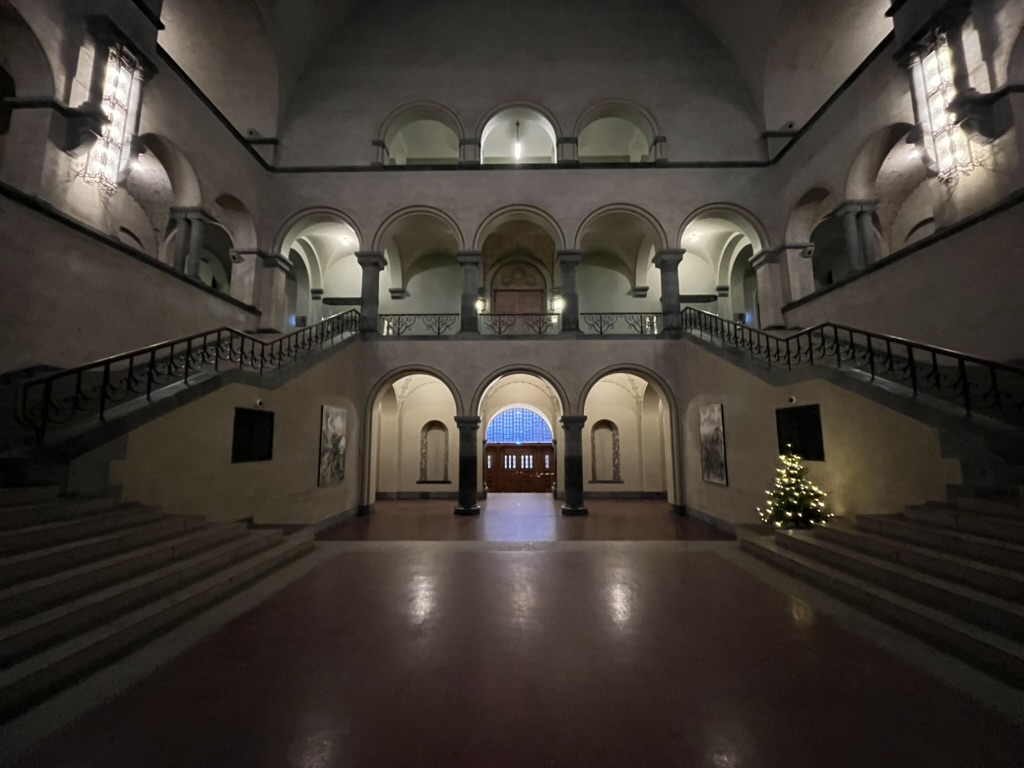
The university has a strong international community, with many exchange students from all over the world. There are many student organizations and clubs, which makes it easy to meet new people and get involved in campus life.
The courses
I took 4 courses during my exchange semestre, which were all taught in English. The courses were:
- Applied Statistics
- Finance for Science and Technology Students
- Applied Cryptography and Networking Security
- Software Security and Data Privacy
Let's take a closer look at each course and the projects I worked on.
- TMA4255: Applied Statistics
This course was focused on the application of statistical methods to real-world problems. Knowledge goals:
- Understand key statistical models and methods in science and technology
- Core topics: hypothesis testing, regression, experimental design, ANOVA (analysis of variance)
- Additional methods: error propagation, process control, contingency tables, non-parametric approach
At the end of the course we were able to:
- Design experiments and collect high-quality data
- Analyse data using statistical software
- Draw valid conclusions from statistical analysis
Projects
The first project was honestly kind of hard. The main goal was to predict hand gesture based on EMG data. We did a bunch of analysis and linear regression and...
... the result was not that good at the end. But we tried and it's what matters!
Grade: A
The second project was easier. We needed to find a experiment where we could proceed to make an ANOVA (analysis of variance). We chose (as a group) to measure the typing speed on a keyboard and the influence of different parameters:
- Language
- Sitting posture
- Type of keyboard
The results did not surprise us in the end, but know we had figures to convince other people !
Grade: A
- TIØ4146: Finance for science and Technology Students
In this course, we focused on the discovery of key concepts in modern finance.
Knowledge goals:
- General: workings of financial markets (arbitrage, equilibrium, risk sharing)
- Specific: risk analysis, risk pricing for real & financial assets (incl. derivatives and options)
- Real options: valuing flexibility in investments and modern market efficiency theory
Additionaly, we gained some skills:
- Apply financial concepts to investment, financing and risk management decisions
- Use practical examples and exercises to connect theory with real-world applications
- Master key areas: market efficiency, capital structure and option pricing (incl. real options)
No projects in this course, just exams.
- TMA4255: Applied Cryptography and Networking Security
As mentionned in the title, the main goal of this class was to understand the main cryptographic algorithms and therefore, how they are used in the case of network security.
Knowledge goals:
- Understand cryptographic algorithms
- Learn key management, distribution, and user authentication techniques
- Apply cryptography in network protocols and applications
- Explore methods for securing computers against intruders and malware
Now that I took this class, I can:
- Evaluate system security based on appropriate services and mechanisms
- Design basic security architectures by selecting and integrating relevant components
Projects
The first project was a practical assignement (solo). We had four cipher texts and we knew that each of them were encrypted using a unique cipher methods (caesar, vigenere, simple substitution, Hill Cipher). Obviously, the goal of the project was to find the key and the plain text.
Grade: 8/8
The second project had three different parts. (group)
- Sending encrypted emails to the other group members using pgp.
- Installing a web server and obtaining a certificate
- Examining TLS traffic on our web server
Grade: 19,25/20
- TDT4237: Software Security and Data Privacy
This class actually covered a vast amount of subjects among software security. By vast, I mean that we've had classes about "Top 10 OWASP", "Threat modeling" or even "AI tools and their impact".
Knowledge goals:
- Understand cryptography concepts and algorithms for web applications
- Explain authentication, access control, GDPR, and data privacy principles
- Compare software engineering practices and standards for secure development
Since we had a big project all semester long to check our knowledge on the subject, we covered many skills such as:
- Identifying and fix common web application vulnerabilities
- Applying threat modeling and risk-based testing methods
- Using AI-assisted tools for software security evaluation
- Critically assessing and applying security practices in real-world scenarios
Projects
Basically, we had a big project that started first week and ended two weeks before exams. It had 4 different parts:
- The first part was kind of special since we had the whole semester to complete it (one month for the other). We had access to "SecureCodeWarrior", a software security website, with exercices about how to write safe code. This part was done solo. (Grade: 20/20)
- In the second part, we (as a group) had to PenTest (penetration testing) a web application and write a report on the vulnerabilities we found (both black and white box). (Grade: 30/30)
- The third part naturally followed the second since we had to fix a list of vulnerabilities. We had access to our group web application github on which we could implement solutions and check wether they worked or not and then push it on production website. We also wrote a report at the end, to show and explain how we corrected the initial code to make it secure. (Grade: 30/30)
- Finally, the fourth part was about Threat modeling & risk management framework. We had a business description and needed to find assets (both business and technical) and threats to these assets, how to protect them and imagine attackers scenarios. We wrote all of this in a report.(Grade: 20/20)
Conclusion
Overall, my ERASMUS exchange in Norway was a great experience. I learned a lot about different cultures and ways of thinking, and I made some great friends from all over the world. The courses were challenging but rewarding, and I feel like I gained a lot of knowledge and skills that will be useful in my future career. I would definitely recommend an ERASMUS exchange to anyone who is considering it!